
Product display is the ultimate sales driver in the modern e-commerce market.
As there is no real touch or assessment of products in the online world, the clients’ purchasing decisions depend on the visual quality.
By 2026, e-commerce companies will have to make a strategic choice: Which do you like better, the old studio photography or the new 3D product rendering?
In this post we will be looking into startup costs, operational scalability and ROI and how Graphics Pixels helps e-commerce companies scale their visual production in an efficient manner.
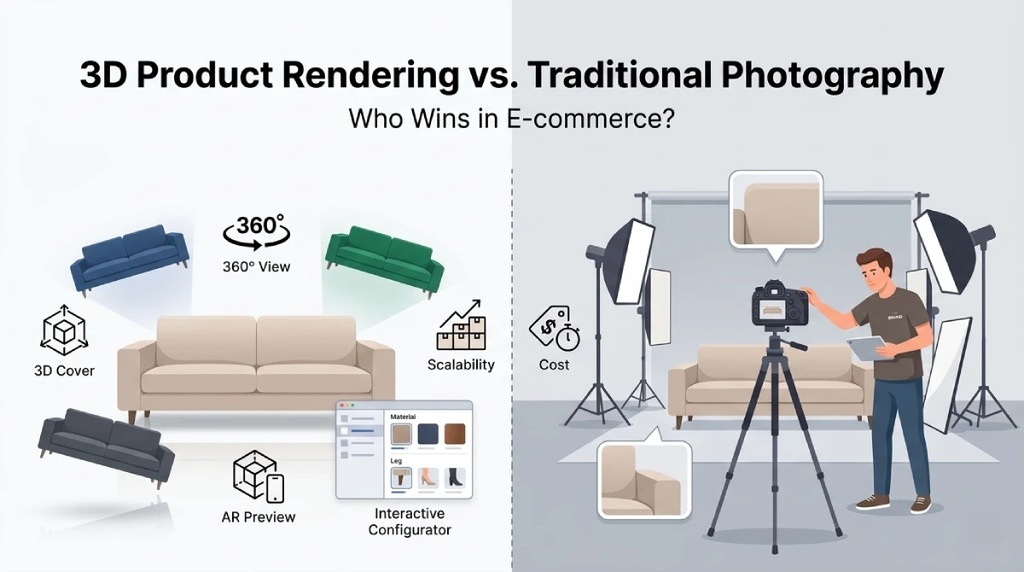
1. Cost Breakdown – Starting & Operating Costs
Vintage Studio Photography
Traditional photography is a recurring cost for each new product introduction/color variation:
- Studio & Equipment Rental: Expensive high end cameras, lighting equipment and physical backdrop installations.
- Shipping & Logistics: Packing, handling and shipping physical samples to and from studios.
- On-Site Talent: Daily rates for photographers, art directors, product stylists and models.
- Post Processing: Cost of background removal, retouching & colour correction ongoing.
3D Product 3D Renderings
Digital resources require an initial investment in rendering, but have low incremental costs:
- CAD / 3D Model Creation: $One time fee to create one master 3D asset from product CAD files or specs.
- Zero Logistics Overhead: No cost for shipping, handling or producing physical samples.
- Fast Asset Swings: You can change textures, lighting angles, materials or colourways in seconds at little cost.
2. Comparative Analysis Matrix
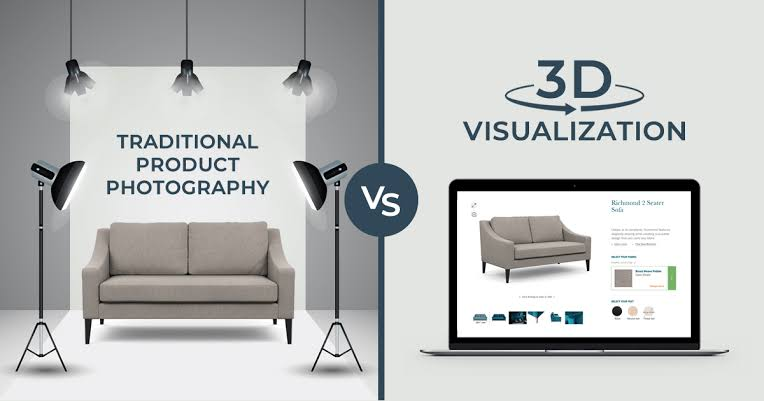
| Feature | Old Photos | 3D Rendering |
| Low to Mid-Range Setup Model | Low upfront cost | High upfront model creation, low marginal cost |
| Scalability | Prices grow linearly with # of SKUs | High; unlimited renders per model |
| Flexibility | Physically disabled | Total control of lighting and atmosphere |
| Price of Color/Variant | Needs to be reshot | Software Updates in clicks |
| AR & Interactive Readiness | Just stills. Not 3D compatible | Support for 360 views & VR3, native AR |
3. Return on Investment (ROI) Assessment
3D rendering drives better long-term ROI, according to 2026 e-commerce benchmarks data:
- CRO Conversion Rate Optimisation: Interactive 3D models and 360-degree product views increase user engagement and can boost conversion rate by 25-40%.
- Reduce Product Returns: Photorealistic rendering helps to accurately depict textures and proportions and can reduce product returns by up to 35% through better customer expectation alignment.
- Faster Time-to-Market: Renders can be created before the physical manufacturing takes place, enabling pre-orders and promotional activities to start early.
4. Why Choose Graphics Pixels?
Graphics Pixels offers high-performance rendering and post-processing services for high conversion for e-commerce businesses trying to optimise product visual assets.
Core Graphics Pixels Advantages:
- Photorealistic 3D Modelling: 3D renders with studio quality capturing material textures, lighting and reflections in detail.
- Cost-effective SKU Scaling: Fast creation of colours, materials and angles for large product catalogues.
- E-Commerce Platform Optimisation: Assets designed for Amazon, Shopify, WooCommerce, and custom enterprise portals.
- Streamlined Workflow: Eliminates physical logistics with effective digital production operations.
Verdict: Strategic path to 2026
Traditional Photography can be useful for artisan or low volume custom products but 3D Rendering is the better choice for scalable e-commerce companies in furniture, electronics, fashion and consumer products.
Contact the visualization specialists at Graphics Pixels today if you want to scale your brand’s visual presentation and achieve measurable sales growth.