
When launching or scaling an online clothing brand, choosing the right visual style for your product catalog is a multi-million dollar decision. In e-commerce, customers cannot touch or try on fabrics, meaning your product photography must do 100% of the selling.
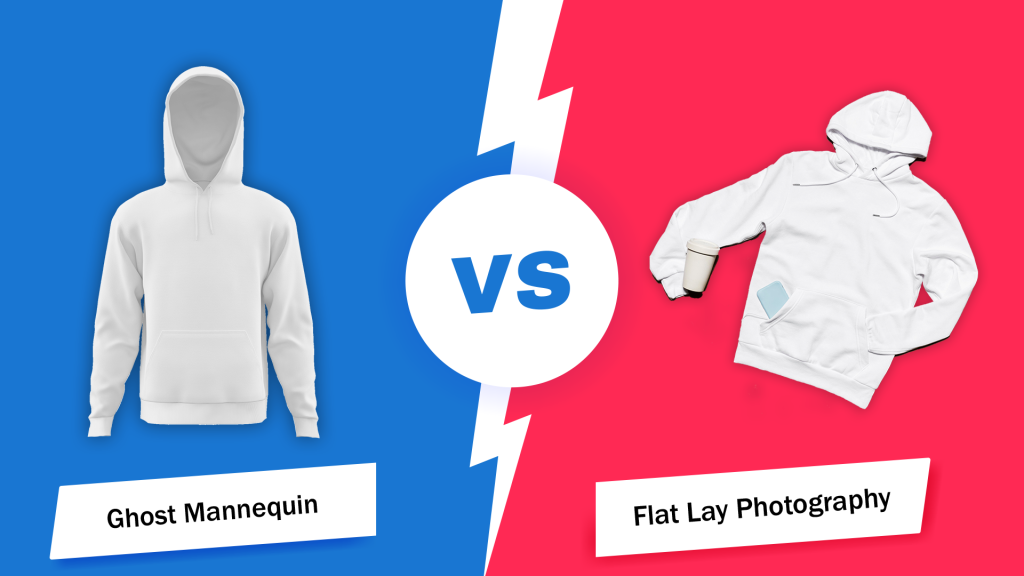
Two dominant visual styles rule the apparel industry: Flat Lay Photography (arranging clothes flat on a surface) and the Ghost Mannequin Effect
But which method offers the best return on investment (ROI)? In this guide, we will look into a data-driven comparison of Flat Lay vs. Ghost Mannequin, analyzing their production costs, labor/effort, and direct impact on e-commerce conversion rates.
Head-to-Head Comparison: Flat Lay vs. Ghost Mannequin
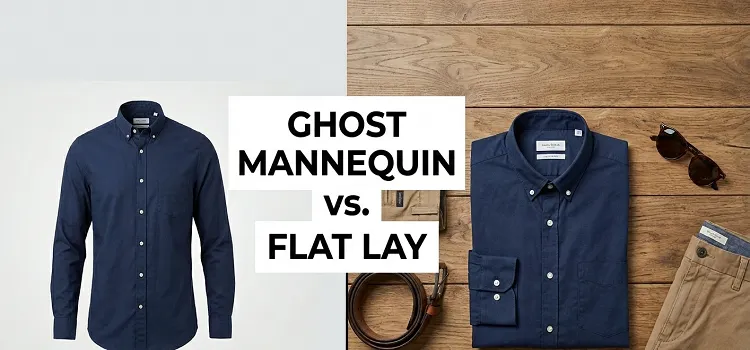
Before breaking down the strategic business metrics, here is a quick technical overview of how these two visual styles stack up against each other:
| Business Metric | Flat Lay Photography | Ghost Mannequin Effect |
| Visual Dimension | 2D (Flat, minimalist, casual) | 3D (Hollow human shape, lifelike fit) |
| Initial Studio Setup Cost | Low (Requires a flat surface/table & overhead lights) | Moderate to High (Requires a modular ghost mannequin) |
| Post-Production Effort | Low to Medium (Basic color correction & cropping) | High (Requires manual vector clipping paths & layer compositing) |
| Average E-commerce Conversion Rate | Baseline / Moderate (Best for basics & accessories) | High (Up to 25%-40% lift for structured apparel) |
| Product Return Rates | Higher (Sizing and drape are harder to judge) | Lower (Accurately communicates real-world fit) |
1. The Financial Breakdown: Production & Post-Production Costs
Flat Lay Photography:
- The Cost: Flat lay is incredibly budget-friendly. You do not need expensive mannequins or live models. A clean floor, a wooden tabletop, or a basic background sheet paired with a top-down lighting setup (or natural window light) is enough to start.
- Post-Production Fees: Editing costs are minimal. Because the clothing is shot flat, retouchers generally only need to fix minor wrinkles, balance the white point, and apply basic background isolation.
Ghost Mannequin Effect:
- The Cost: The upfront investment is higher. Your studio needs a specialized, modular ghost mannequin with removable magnetic segments (which can cost between $300 to $900).
- Post-Production Fees: Ghost mannequin editing is a premium service. It requires skilled photo editors to manually draw vector clipping paths, merge the outer shots with the inner neck-tag lining, and hand-craft realistic internal shadows. However, for scaling brands, this cost is easily offset by bulk outsourcing discounts.
2. Labor and Effort: Studio Workflow and Speed
- Flat Lay (The Fast Lane): Laying clothing flat is quick. You can cycle through dozens of garments in an hour. It is highly efficient for fast-fashion brands that launch hundreds of new casual items, streetwear graphic tees, or basic socks weekly. The primary challenge is styling the fabric to look dynamic rather than lifeless.
- Ghost Mannequin (The Meticulous Method): Dressing a mannequin takes time. Photographers must carefully steam the garment, fit it symmetrically onto the form, use styling clips to pull it taut, and then take multiple exposures (front, back, and inner lining). It requires more studio hours per product line but yields an incredibly professional, high-end catalog layout.
3. The Conversion Driver: Which Style Sells More?
This is where the Ghost Mannequin Effect takes a massive lead for structured apparel.
The Psychology of the 3D Fit:
When a consumer views a flat-lay photo of a blazer, winter jacket, or premium evening dress, their brain struggles to calculate how that fabric will drape over their chest, shoulders, and waist. Flat lays compress 3D dimensions into a flat, 2D plane.
The Ghost Mannequin effect provides immediate spatial awareness. Buyers can visualize the depth of the sleeves, the taper of the waistline, and the true silhouette of the garment. According to e-commerce consumer statistics, upgrading from flat lay to ghost mannequin for structured apparel can boost online conversion rates by 25% to 40%.
The Hidden Revenue Saver: Lower Return Rates
A primary reason for clothing returns on platforms like Shopify or Amazon is “poor fit.” Because ghost mannequin photography accurately displays the contours and volume of the apparel, customer expectations align perfectly with reality. This transparent presentation can drop apparel return rates by up to 18%, instantly saving brands thousands of dollars in reverse logistics and shipping overhead.
Expert Verdict: When to Choose Which?
- Choose Flat Lay Photography If: You are running a budget-conscious startup, selling unstructured casual wear (tees, hoodies, sportswear), marketing accessories (socks, scarves, hats), or building a highly stylized, aesthetic grid for Instagram marketing.
- Choose Ghost Mannequin If: You are an established e-commerce brand selling mid-to-high-end structured clothing (suits, denim, coats, dresses, button-down shirts), optimizing your product listings for Amazon/marketplaces, or trying to minimize high product return rates.
Frequently Asked Questions
Q: Does flat lay or ghost mannequin photography convert better for apparel stores?
A: For structured clothing lines like jackets, dresses, denim, and button-up shirts, ghost mannequin photography converts significantly better, often driving a 25% to 40% increase in sales. This is because the 3D, hollow human shape allows shoppers to accurately evaluate the fit, drape, and volume of the garment, which flat-lay photography cannot convey.
Q: Why is ghost mannequin photography more expensive than flat lay?
A: Ghost mannequin photography is more expensive due to both studio equipment costs and advanced post-production requirements. Photographers must purchase modular mannequins and capture multiple exposures of each item. Photo editors then use meticulous, hand-drawn vector paths to merge the outer garments with the inner joint shots, creating a clean, professional composite.
Q: Can flat lay photography help reduce e-commerce returns?
A: Flat lay photography is less effective at reducing returns compared to ghost mannequin views because flat layouts flatten the garment’s true dimensions. The ghost mannequin technique accurately showcases the real-world shape and fit of the apparel, aligning customer expectations and dropping product return rates by up to 18%.